At 6,237 feet above sea level, your Jackson Hole home office isn’t battling ordinary sunlight. You’re working under UV radiation that’s 25% more intense than at sea level (Source: National Park Service UV Index Guidelines, 2022), bouncing off snow-covered peaks for eight months and reflecting off those stunning floor-to-ceiling windows that sold you on your Teton Village contemporary home. By 10 a.m., your monitor becomes unreadable. By noon, your west-facing desk feels like a solar oven. Interior blinds? They trap that heat inside with you.
If you’ve relocated to Jackson Hole for remote work—joining the 32% of Wyoming workers now working from home at least part-time (Source: U.S. Census Bureau American Community Survey, 2023)—you already know this valley’s light is different. This guide explains why exterior solar shades are the only solution engineered for our specific high-altitude challenges, and how they protect your productivity, your furniture, and your Lower Mountain Power bill without blocking your reason for living here: the views.
Why Jackson Hole’s High-Altitude Sun Destroys Home Office Productivity
The Science Behind 6,200-Foot UV Intensity
Every 1,000 feet of elevation gain increases UV exposure by approximately 8-10% (Source: World Health Organization UV Radiation Fact Sheet, 2023). Your Aspens neighborhood home office absorbs 50-60% more UV damage than an identical setup in Denver. That’s not marketing—it’s atmospheric physics. Thinner air means less UV filtration before sunlight hits your glass.
The contemporary mountain modern architecture dominating Jackson Hole compounds this problem beautifully. Architects designed those expansive glass walls to frame Snow King Mountain and capture natural light. They didn’t design them for eight-hour Zoom calls where your face alternates between blown-out bright and harsh shadow. Interior solutions like cellular shades or roller blinds react to light after it penetrates your glass—by then, up to 87% of solar heat has already entered your home (Source: U.S. Department of Energy Window Technologies Report, 2023).
Real Costs of Uncontrolled Solar Heat Gain
Your Lower Mountain Power summer bills tell the story. Homes with extensive west-facing glass in Teton Village regularly report cooling costs 40% higher than comparable square footage with standard window configurations. But the invisible costs hurt worse:
- Furniture fading: Unfiltered UV destroys leather, hardwood, and artwork. Museum-quality UV exposure guidelines recommend maximum 5 UV microwatts per lumen—your unshaded window delivers 75+ (Source: American Institute for Conservation, 2022)
- Screen glare: Productivity studies show glare-induced eye strain reduces work output by 15-20% (Source: Cornell University Ergonomics Research, 2021)
- HVAC cycling: Your system runs constantly fighting solar heat gain, increasing wear and shortening equipment lifespan
How Exterior Solar Shades Solve the Problem at the Source
Blocking Heat Before It Enters Your Glass
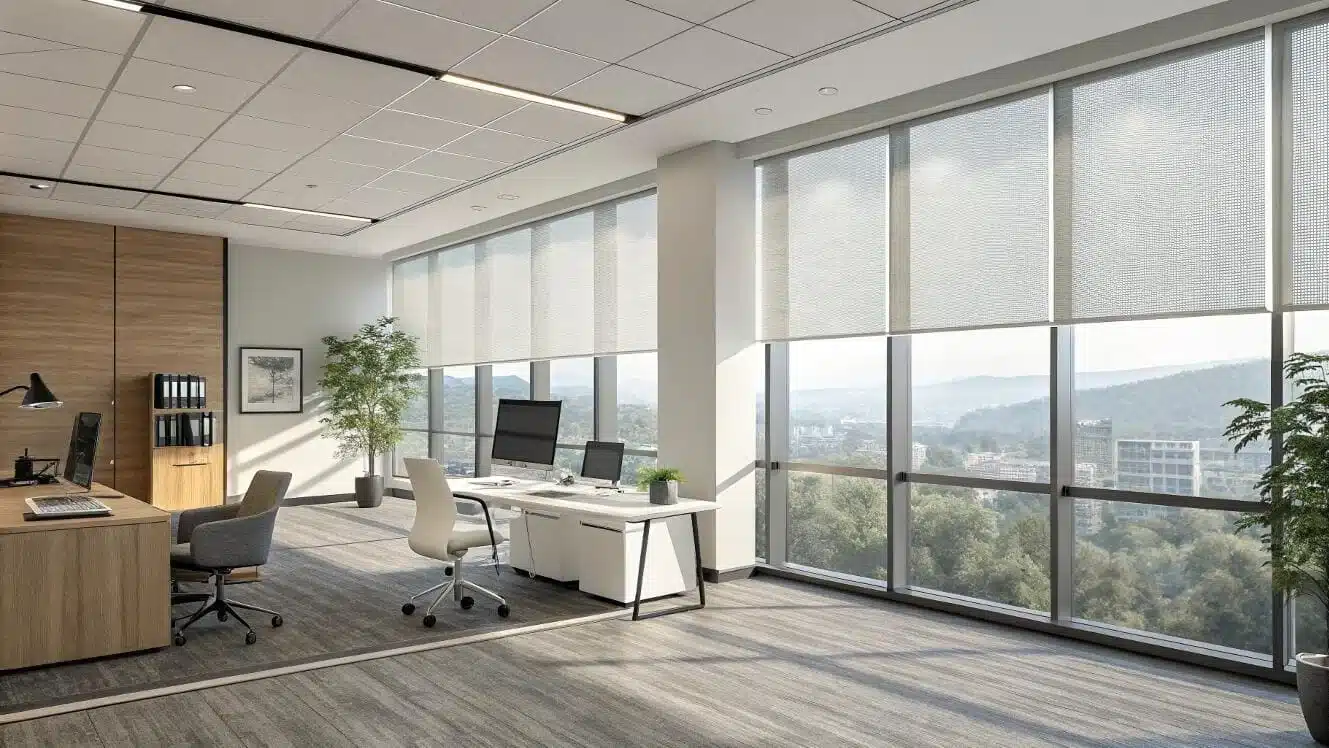
Exterior solar shades intercept solar radiation on the outside of your window, stopping up to 90% of heat before it touches your glass (Source: Lawrence Berkeley National Laboratory Windows and Daylighting Research, 2022). This isn’t incremental improvement over interior blinds—it’s a fundamentally different approach. Your air conditioning works less. Your home office temperature stabilizes. Your views remain unobstructed because modern shade fabrics are engineered for transparency when looking outward.
For Jackson Hole’s specific conditions, exterior screens must handle:
- Wind loads during afternoon thunderstorms sweeping across Jackson Hole Mountain Resort
- Snow and ice accumulation from October through May
- Intense UV degradation that destroys cheap fabrics within two seasons
- Wildlife considerations—elk, moose, and deer don’t respect property lines in Aspens
Fabric Selection for Mountain Modern Architecture
Your contemporary home’s clean lines demand shade systems that complement rather than compete. The most effective exterior solar shade fabrics for Jackson Hole applications balance three factors:
| Fabric Type | Openness Factor | Best Application | View Preservation |
|---|---|---|---|
| High-density mesh | 1-3% | West-facing home offices | Moderate |
| Medium-density mesh | 5-10% | Living areas, bedrooms | Excellent |
| Solar screen | 10-14% | Covered patios, north windows | Maximum |
A 5% openness fabric blocks 95% of UV while maintaining clear sightlines to the Tetons from your desk. You’ll see the mountain; the mountain won’t overheat your office.
Installation Considerations for Teton Village and Aspens Properties
Mounting Systems That Handle Valley Weather
Jackson Hole isn’t Scottsdale. Exterior shade systems installed here must survive wind gusts exceeding 60 mph during spring storms, snow loads that would collapse cheap hardware, and temperature swings from -25°F to 85°F within the same year. Proper installation requires:
- Commercial-grade track systems that secure fabric against wind lift
- Stainless steel or powder-coated aluminum hardware rated for mountain environments
- Automated sensors that retract shades when wind speed exceeds safe thresholds
- UV-stabilized fabrics warrantied for minimum 10 years at high altitude
Your Teton Village home likely sits on a slope with complex wind patterns influenced by Jackson Hole Mountain Resort’s terrain. Generic installation approaches fail here. Site-specific assessment determines mounting angles, track lengths, and automation requirements.
Permit and HOA Considerations
Many Aspens properties operate under architectural guidelines requiring exterior modification approval. Teton Village condominiums typically require association review. Starting this process early prevents project delays. Most exterior solar shade systems qualify as removable, non-structural improvements, simplifying approval timelines compared to permanent construction.
“We help homeowners navigate Teton County’s building requirements every week. Exterior shade systems rarely require full building permits when properly specified as temporary fabric installations rather than permanent structures.”
Choosing the Right Exterior Solar Shade System for Your Home Office
Manual vs. Motorized Operation
For dedicated home office windows, motorized systems with programmable schedules eliminate the daily ritual of adjusting shades as the sun tracks across your workspace. You program morning deployment and evening retraction; the system handles everything automatically. Premium systems integrate with smart home platforms, allowing voice control or app-based adjustment during video calls when lighting needs change.
Manual crank systems cost 30-40% less upfront but require physical effort multiple times daily. For frequently used home office windows, the convenience premium of motorization pays back quickly in time savings and consistent glare control.
Color Selection Strategy
Darker exterior fabrics block more light but absorb more heat into the fabric itself. Lighter colors reflect more solar energy away from your home entirely. For Jackson Hole’s intense summer sun, medium-tone fabrics in bronze, charcoal, or forest green balance heat rejection with view clarity and aesthetic compatibility with mountain modern exteriors.
Your view through the fabric matters too. Dark fabrics viewed from inside during bright conditions provide clearer outward visibility than light fabrics—counterintuitive, but optically accurate.
Investment Protection: What Quality Exterior Shades Actually Cost
Homeowners in Jackson Hole typically invest between $800 and $2,500 per window for properly engineered exterior solar shade systems including professional installation. Variables affecting your cost include:
- Window dimensions: Floor-to-ceiling glass walls common in mountain modern homes require larger, stronger systems
- Motorization: Adds $300-600 per shade but essential for oversized installations
- Fabric quality: 10-year warranted UV-stable mesh vs. 3-year budget alternatives
- Installation complexity: Second-story windows, unusual mounting surfaces, smart home integration
Compare this against replacing faded furniture, elevated Lower Mountain Power cooling bills, and the productivity cost of fighting glare every workday. Most Jackson Hole homeowners recover their exterior shade investment within 3-5 years through energy savings and avoided replacement costs alone.
Take Control of Your Jackson Hole Home Office Environment
You moved to Jackson Hole for the mountains, not to fight them every workday. Exterior solar shades let you enjoy those Teton Village views without sacrificing productivity, comfort, or your furniture to high-altitude UV assault. Interior blinds were never designed for this elevation. Exterior intervention stops the problem before it starts.
Schedule your free exterior shade consultation and experience glare-free mountain living. We’ll assess your specific window orientations, discuss fabric options suited to your home’s architecture, and provide a detailed proposal covering installation timeline and investment. Your home office deserves the same quality of life that brought you to Jackson Hole—without the constant battle against the sun.
Get a free quote today and discover why homeowners from Aspens to Teton Village trust exterior solar shades to protect their investment and their eyesight.
Frequently Asked Questions
How long do exterior solar shades last in Jackson Hole’s harsh weather conditions?
Quality exterior solar shades with UV-stabilized fabrics and commercial-grade hardware typically last 12-15 years in Jackson Hole when properly maintained. Budget systems using inferior materials may fail within 3-4 seasons due to UV degradation and wind damage. Annual inspection of tracks, motors, and fabric tension extends system lifespan significantly.
Can exterior solar shades be installed on second-story windows in mountain homes?
Yes, second-story installation is common for Jackson Hole properties with multi-level glass walls. These installations require specialized equipment, safety rigging, and often custom-length tracks. Motorization becomes essential for upper-floor shades since manual operation isn’t practical. Installation costs increase approximately 25-35% compared to ground-level windows.
Do exterior solar shades work during winter months when the sun angle is lower?
Winter sun in Jackson Hole sits at a much lower angle, actually increasing glare problems for south-facing home offices. Exterior shades remain effective year-round and can be adjusted or retracted during heavy snowfall. Many homeowners use lighter deployment settings in winter to capture passive solar heat while still controlling glare during work hours.
Will exterior shades void my window warranty or damage window frames?
Properly installed exterior shade systems mount to wall surfaces or fascia boards, not directly to window frames. This approach preserves window warranties and avoids frame damage. Professional installers use non-penetrating attachment methods when required by window manufacturer specifications or HOA guidelines common in Teton Village developments.