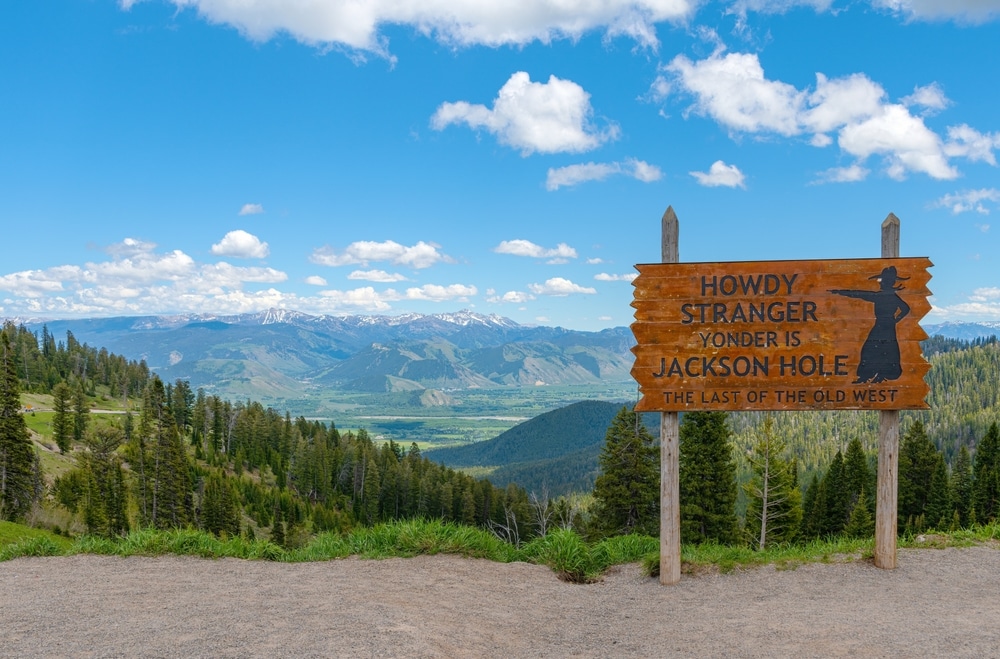
When winter sun bounces off fresh powder and slams through your floor-to-ceiling glass at 3 Creek Ranch, you’re not just dealing with glare—you’re dealing with UV intensity 25% higher than sea level (Source: National Oceanic and Atmospheric Administration UV Index Data, 2022). That same south-facing great room that perfectly frames Grand Teton is fading your $40,000 sectional and turning your living space into a greenhouse by mid-morning.
This is the signature challenge of Jackson Hole architecture: massive panoramic windows designed to showcase the most dramatic mountain views in North America, paired with alpine conditions that punish unprotected interiors. Standard window treatments from big-box retailers max out at 96 inches—roughly half the width you actually need. If you own a home in Fish Creek, Teton Village, or Jackson Hole Golf & Tennis, you already know this frustration.
Why Standard Window Treatments Fail Jackson Hole Homes
The residential architecture dominating Teton County bears almost no resemblance to typical American housing stock. While the average U.S. window measures 36 by 48 inches (Source: American Architectural Manufacturers Association, 2021), Jackson Hole luxury homes routinely feature window walls exceeding 240 inches wide and 20 feet tall. This creates three critical problems that generic solutions cannot address:
The Size Gap Nobody Talks About
National window treatment chains build their inventory around median home sizes. When you request a quote for your Teton Village great room, they’ll often propose multiple smaller shades mounted side-by-side—creating visible seams that slice through your Snake River valley view like telephone wires. Your windows cost $800 to $1,200 per linear foot to install. Why compromise them with patchwork solutions?
High-Altitude UV Demands Specialized Fabrics
At Jackson Hole’s 6,237-foot elevation, you receive approximately 25-30% more ultraviolet radiation than residents at sea level (Source: World Health Organization Global Solar UV Index, 2023). Standard window films and light-filtering fabrics rated for coastal or lowland installations degrade faster here. Within 18-24 months, you’ll notice yellowing, brittleness, and diminished UV blocking capacity—right when your warranty expires.
Snow Glare Requires Different Engineering
From November through April, Jackson Hole homeowners face a phenomenon rarely considered in conventional window treatment design: snow reflection can amplify incoming light intensity by 80-90% (Source: U.S. Environmental Protection Agency SunWise Program, 2020). A shade system adequate for summer conditions becomes nearly useless when fresh powder blankets the Bridger-Teton National Forest slopes visible from your living room.
Large Window Shade Solutions That Actually Work at Altitude
Protecting your investment while preserving your Teton views requires equipment and expertise specifically calibrated for mountain conditions. Here’s what your Jackson Hole home actually needs:
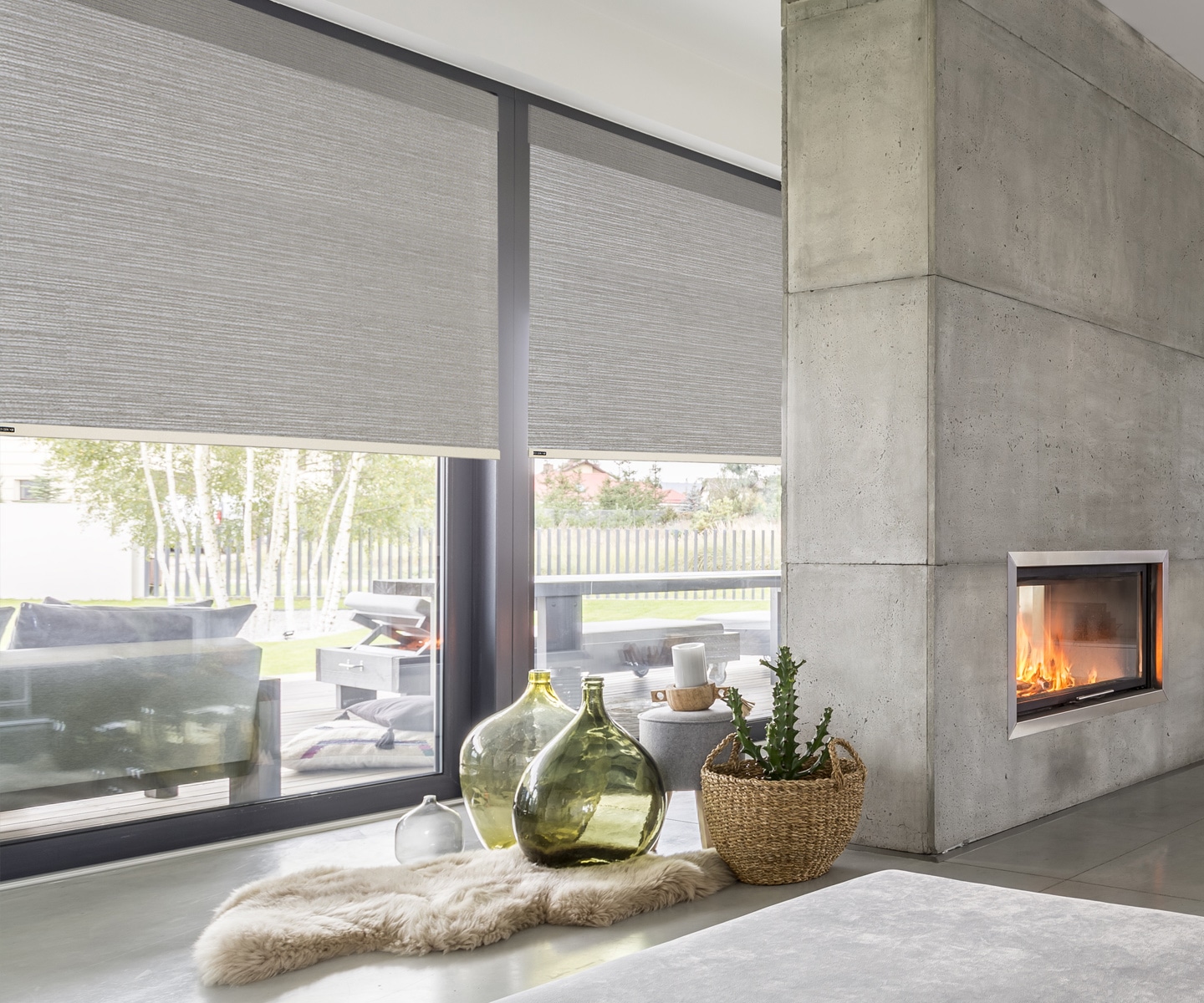
Motorized Roller Systems for Seamless Coverage
Single-panel motorized roller shades can now span up to 20 feet wide without center seams, using commercial-grade aluminum tubes and high-torque motors. For your Fish Creek picture window or 3 Creek Ranch great room, this means uninterrupted fabric coverage that doesn’t compromise the architectural intent. Quality motorized systems also integrate with home automation, allowing you to program seasonal adjustments—critical when your winter and summer light conditions differ so dramatically.
Dual-Layer Systems for Year-Round Flexibility
Many Jackson Hole homeowners discover that no single shade handles both summer heat gain and winter snow glare effectively. A dual-layer approach pairs a light-filtering solar shade (typically 3-5% openness) for summer UV control with a secondary blackout or room-darkening shade for winter’s reflective assault. The motorized stack tucks invisibly into a ceiling pocket, deploying whichever layer your conditions demand.
High-Performance Fabric Selection
Fabric choice matters more at altitude than anywhere else. Look for these specifications:
- UV blocking rate of 95% or higher—standard “UV protection” claims often mean only 70-80%
- Fade-resistant solution-dyed fibers rather than surface-coated materials that degrade faster
- Glare reduction ratings specifically tested for high-reflectivity environments
- GREENGUARD Gold certification for low off-gassing in your sealed mountain home
| Fabric Type | UV Block | Glare Reduction | View Preservation | Best For |
|---|---|---|---|---|
| Solar Screen 1% | 99% | Excellent | Minimal | South-facing, summer |
| Solar Screen 5% | 95% | Good | Good | Year-round balance |
| Solar Screen 10% | 90% | Moderate | Excellent | View priority |
| Blackout | 100% | Complete | None | Winter snow glare |
Energy Impact: What Lower Valley Energy Bills Reveal
Your oversized windows don’t just affect comfort—they hit your wallet through Lower Valley Energy every month. According to the U.S. Department of Energy, heat gain and loss through windows accounts for 25-30% of residential heating and cooling energy use (Source: U.S. Department of Energy Windows and Doors Energy Efficiency, 2023). In Jackson Hole’s extreme climate, that percentage skews even higher.
Summer Heat Gain Calculations
A south-facing 200-square-foot window wall without treatment can introduce over 50,000 BTUs of solar heat gain per day during July (Source: ASHRAE Handbook of Fundamentals Solar Heat Gain Coefficients, 2021). That’s equivalent to running a space heater on high for eight hours—in a home you’re paying to cool. Properly specified solar shades with a 0.15 or lower solar heat gain coefficient can reduce this load by 70-80%, potentially saving $400-600 annually on summer cooling costs.
Winter Heat Loss Prevention
Conversely, those same windows lose heat rapidly on -20°F January nights. Cellular or honeycomb shades with sealed side tracks create an insulating air pocket that can reduce window heat loss by up to 40% (Source: ENERGY STAR Window Attachment Guidelines, 2022). For Jackson Hole homeowners heating with propane or electric baseboards, this translates to meaningful monthly savings through your Lower Valley Energy account.
Why Jackson Hole Homeowners Trust Local Expertise: With over 15 years serving Teton County, we’ve installed large window treatments in more than 400 mountain homes—from modest Fish Creek cabins to 12,000-square-foot 3 Creek Ranch estates. Our installation teams are trained specifically for high-altitude conditions, using hardware rated for temperature swings from -30°F to 95°F. We guarantee our work for 10 years, including motor function and fabric UV performance.
Installation Realities for Oversized Window Systems
Even the best shade system fails if installation doesn’t account for Jackson Hole’s unique structural and environmental factors. Here’s what proper large window installation requires:
Structural Assessment First
A 20-foot motorized shade with commercial-grade hardware weighs 75-150 pounds. Your ceiling or header must handle this load without deflection—especially in log or timber-frame construction common throughout Teton Village and Jackson Hole Golf & Tennis. Professional installers assess structural capacity before specifying mounting solutions, sometimes recommending steel reinforcement brackets or distributed load systems.
Electrical Planning for Motorization
Hardwired motorized shades require dedicated circuits, ideally installed during construction or major renovation. For retrofit situations, battery-powered or rechargeable motor options eliminate electrical work while providing 12-18 months of operation between charges—practical for Jackson Hole’s remote locations where electrician availability can delay projects by weeks.
Cold-Weather Hardware Requirements
Standard plastic components become brittle and fail in Jackson Hole winters. Your hardware package should specify:
- Aluminum or stainless steel brackets rated to -40°F
- Motors with low-temperature lubricants that won’t seize in January
- Fabric tensioning systems that accommodate thermal expansion and contraction
- Sealed electrical connections resistant to condensation common in temperature-swing environments
Investment Ranges for Jackson Hole Picture Windows
Quality large window shades for Jackson Hole homes represent a significant but protective investment. Expect these ranges for professional solutions:
- Manual roller shades (up to 12 feet wide): $1,200-2,500 installed
- Motorized single-layer systems (12-20 feet): $3,500-7,000 installed
- Dual-layer motorized with ceiling pocket: $6,000-12,000 installed
- Full-home systems (5+ large windows): $25,000-60,000 with automation integration
These figures reflect commercial-grade equipment appropriate for Teton County conditions—not residential-grade products marked up for the mountain market. Request itemized quotes separating fabric, hardware, motors, and labor costs to compare proposals accurately.
Ready to protect your views and your investment? Schedule your large window treatment consultation with Jackson Hole’s view-preservation experts. We’ll assess your specific window configurations, light exposure patterns, and aesthetic preferences to recommend solutions engineered for mountain performance.
Frequently Asked Questions
How long do motorized shade motors last in Jackson Hole’s temperature extremes?
Quality motors specified for mountain conditions typically deliver 15-20 years of service with proper maintenance. We recommend annual lubrication checks before winter and use only motors rated for -40°F to 140°F operational ranges. Battery-powered options may require more frequent attention, with rechargeable units needing top-offs every 6-9 months during heavy-use seasons.
Can I control large window shades remotely when I’m away from my Jackson Hole property?
Yes—most modern motorized systems integrate with WiFi-enabled smart home platforms, allowing you to operate shades via smartphone from anywhere. This proves especially valuable for part-time Jackson Hole residents who want to protect interiors from sun damage during extended absences or stage the home for arriving guests without being present.
Do large window treatments require any special permitting in Teton County?
Interior window treatments typically don’t require permits in Teton County. However, if your installation involves structural modifications—such as reinforcing headers for heavy motorized systems or adding electrical circuits—those components may need permits. Your installer should clarify which aspects require approval and handle documentation if needed.
Frequently Asked Questions
How long do motorized shade motors last in Jackson Hole’s temperature extremes?
Quality motors specified for mountain conditions typically deliver 15-20 years of service with proper maintenance. We recommend annual lubrication checks before winter and use only motors rated for -40°F to 140°F operational ranges. Battery-powered options may require more frequent attention, with rechargeable units needing top-offs every 6-9 months during heavy-use seasons.
Can I control large window shades remotely when I’m away from my Jackson Hole property?
Yes—most modern motorized systems integrate with WiFi-enabled smart home platforms, allowing you to operate shades via smartphone from anywhere. This proves especially valuable for part-time Jackson Hole residents who want to protect interiors from sun damage during extended absences or stage the home for arriving guests without being present.
Do large window treatments require any special permitting in Teton County?
Interior window treatments typically don’t require permits in Teton County. However, if your installation involves structural modifications—such as reinforcing headers for heavy motorized systems or adding electrical circuits—those components may need permits. Your installer should clarify which aspects require approval and handle documentation if needed.